


Publications
ACADEMIA.EDU
2026
Forthcoming:
—Chapter in Vegetal Futures: Unfurling Worlds to Come. Carabelli, G., Ginn, F., and Beach, M. Eds. London: Bloomsbury Academic.
—An aesthetics of life (for the struggles and joys of decolonization). Ruth Sonderegger and Imayna Caceres. In: A Decolonial Manual. Valery Vinogradovs. Ed. California: Punctum books.
2025
Decolonizing Knowledge:
Decolonizing Knowledge:
Imayna Caceres. In: Detour / Umwege / Desvíos: Künstlerische Wissenspraktiken als dekoloniale Strategien/ Artistic knowledge practices as decolonial strategies. Ed. Mariel Rodríguez and Amalia Barboza. Oktober 2025. Art Historicum Universitätsbibliothek Heidelberg.
2025
Underground worlds
A is for Assembling. Body and Performance Practices. TQW Paper. Mai 2025. Tanzquartier Wien.
2025
Guaman Poma de Ayala
"Die Neue Chronik und gute Regierung (1615) Guaman Poma de Ayala. Kommentar und Diskussion". Ruth Sonderegger and Imayna Caceres. In: Stimmen des Antikolonialismus. Eine globalhistorische Spurensammlung 1615-1915. Lucile Dreidemy, Johannes Knierzinger, David Mayer, Clemens Pfeffer (Hg.). März 2025. Mandelbaum Verlag.
"Die Neue Chronik und gute Regierung (1615) Guaman Poma de Ayala. Kommentar und Diskussion". Ruth Sonderegger and Imayna Caceres. In: Stimmen des Antikolonialismus. Eine globalhistorische Spurensammlung 1615-1915. Lucile Dreidemy, Johannes Knierzinger, David Mayer, Clemens Pfeffer (Hg.). März 2025. Mandelbaum Verlag.
Rituals and Co-reasonings/Presentiments (EN)
Imayna Caceres, Adriana Ciudad, Ana Zavala
In BISAGRA 005: "Presagios y Destinos Compartidos".

That wisdom about these forms of coexistence exists in many traditions of care and healing and is very useful in times of crisis, of disorder, of chaos. And that is why rituals are also a practical reaffirmation and reactivation of knowledge and critical positions. In my experience, I have learned to understand rituals as a political technology of inter-species reciprocity and re-linking. A moment of fusion of the spheres in which we exist. A portal through which subterranean pains and memories come to the surface. A tool to question fetishistic processes of alienation, to question hegemonic apparatuses, and to create a sense of community. In this sense, rituals can be understood as a political rethinking of the ways in which we want to live and a confrontation with the orders that have led us to the current anthropogenic crisis. A practice that is ultimately artistic, insofar as it requires us as sentient (of sense, senses, and sensibility) beings."
Thinking through Art, Drawing and Performance Ontological Conflicts That Are at the Core of Mining Struggles
Imayna Caceres and Alfredo Ledesma
In fiar 15.2 Struggles over Mining and Territory in Latin America

 Threads that intertwine, break, and remake tissues: Practices of connection and care of life
Imayna Caceres
In Texte zur Kunst
2022
I focus in this text on modes of being with others – human and non-human – that emerged in my migration experience as binding connections and repairing lessons concerning acceptance, community, and kinship.

Multispecies dance movements through endangered worlds
About Amanda Piña's Climatic Dances
In Tanzquartier Magazin
Imayna Caceres
2021
What might happen to co-existing communities that are more-than-human, if corporate extractivism continues to be allowed to wreck life, affecting a large multiplicity of ecosystems and modes of living? For Amanda Piña, who has been observing these effects on the Apu Wamani mountain-being located near Santiago de Chile, close to where she grew up and where part of her family still lives, this is a distinctly troubling question. Through highland ritual dances, her aim is to channel the power of coming together towards active modes of co-survivance. Breathing with her entrails glittering on the tongue that greets us, Piña as incarnated mountain-being conjures dances as a catalog of movements-with-the-other which are part of the complex being which is (with) the Apu mountain. Traditional ritual dances, unlike what their name seems to suggest, don’t remain static. Rather, each body that dances it transforms the dance, and so the dance continues to grow like a living being. These dances constitute a body-based knowledge that understands ‘humans’ as having been artificially separated from ‘nature’, and recognizes symbiotic relations to other earth-beings, maintaining an invested relationality with the whole of the cosmos. As practices of reciprocity that retain an awareness of our radical interdependence, and where the artistic is spiritual, social, functional and worldly, intertwined with all spheres of life. Facing the current multiple socioecological crises, we urgently need artistic practices that invite us (as Climatic Dances does) to take another look at how, in certain modes of existing, thinking, and moving with others, alternative ways of creating knowledge might surface.
Imayna Caceres, Adriana Ciudad, Ana Zavala
In BISAGRA 005: "Presagios y Destinos Compartidos".
2023
That wisdom about these forms of coexistence exists in many traditions of care and healing and is very useful in times of crisis, of disorder, of chaos. And that is why rituals are also a practical reaffirmation and reactivation of knowledge and critical positions. In my experience, I have learned to understand rituals as a political technology of inter-species reciprocity and re-linking. A moment of fusion of the spheres in which we exist. A portal through which subterranean pains and memories come to the surface. A tool to question fetishistic processes of alienation, to question hegemonic apparatuses, and to create a sense of community. In this sense, rituals can be understood as a political rethinking of the ways in which we want to live and a confrontation with the orders that have led us to the current anthropogenic crisis. A practice that is ultimately artistic, insofar as it requires us as sentient (of sense, senses, and sensibility) beings."
"In parallel, I also live the ritual by seeking to establish a connection with the beings that inhabit my neighborhood, paying daily attention to the neighboring plants I come across every day. Or with the beings that live in the space of my house, whom I thank for their work that makes the micro-ecosystem within my home possible. There I also have a small altar dedicated to my loved ones, which connects me affectively with that which exists beyond the visible.
Thanks to Bisagra, a Lima based project that aims to generate connections, circulate ideas, projects and experiments in areas of research and creation.
Thinking through Art, Drawing and Performance Ontological Conflicts That Are at the Core of Mining Struggles
Imayna Caceres and Alfredo Ledesma
In fiar 15.2 Struggles over Mining and Territory in Latin America
Ann-Kathrin Volmer, Anna Preiser, Tyanif Rico Rodríguez, Eds.
2022
2022

"In my experience, the artistic practice of drawing makes us pay attention to what we are able to perceive in the shapes, languages and properties of things and beings, in their livingness, and through this, to come across other forms of knowing. A knowing that takes place through our senses, through the materiality of our body and through the standpoint of our multiple identities.
...Through drawing I employ speculative ways of associating information, making unexpected connections. As an extensive web, made of threads, knots and entanglements, which break creating gaps but that also generate structures of interaction and open new questions.
...I come from a history that does not begin with writing as a way of creating and archiving knowledge, but with the language of other natures-cultures, of colors, of drawing, murals, khipus, knotting, textile weaving, ceramics, stonework and more.
...Through drawing I employ speculative ways of associating information, making unexpected connections. As an extensive web, made of threads, knots and entanglements, which break creating gaps but that also generate structures of interaction and open new questions.
...I come from a history that does not begin with writing as a way of creating and archiving knowledge, but with the language of other natures-cultures, of colors, of drawing, murals, khipus, knotting, textile weaving, ceramics, stonework and more.
...knowledge as layers of learnings, erasures and reconstructions. A layered sedimentation of experience that has been passed down from the earliest forms of Life.
...the dialogue on territory already begins at a disadvantage for [indigenous] groups, which are unable to assert their political-spiritual relationship with the cosmos in their dealing with the state."
Thanks to Anna Preiser for the invitation to write. The forum for inter-american research (fiar) is the official electronic journal of the International Association of Inter-American Studies (IAS). fiar was established by the American Studies Program at Bielefeld University in 2008.
...the dialogue on territory already begins at a disadvantage for [indigenous] groups, which are unable to assert their political-spiritual relationship with the cosmos in their dealing with the state."
Thanks to Anna Preiser for the invitation to write. The forum for inter-american research (fiar) is the official electronic journal of the International Association of Inter-American Studies (IAS). fiar was established by the American Studies Program at Bielefeld University in 2008.
 Threads that intertwine, break, and remake tissues: Practices of connection and care of life
Imayna Caceres
In Texte zur Kunst
2022
I focus in this text on modes of being with others – human and non-human – that emerged in my migration experience as binding connections and repairing lessons concerning acceptance, community, and kinship.
"When referring to the spiritual, I do not wish to make reference to private beliefs or a personal/collective connection to religion. Instead, by spiritual, I mean a practical, nurturing relation to a materiality or ecosystem (local and cosmic) that is practiced out of need. A care of the relationships with what keeps us alive, which is the basic condition for our life to exist."
"Reflecting on my migration highlighted what I experienced as forms of repair that were connected to a sense of care and renewal."
"Through drawing, painting, dancing, and collective actions, one is able to revise personal experiences, ground the lessons received, and process these insights bodily. The evoked arts and practices, intertwined with rhythmic language, scientific knowledge, and political-spiritual lessons (which are drawn from the ecosystems with which we coexist), contribute to the processing of memories, tracing affectively what is deemed necessary to remember."
"Reflecting on my migration highlighted what I experienced as forms of repair that were connected to a sense of care and renewal."
"Through drawing, painting, dancing, and collective actions, one is able to revise personal experiences, ground the lessons received, and process these insights bodily. The evoked arts and practices, intertwined with rhythmic language, scientific knowledge, and political-spiritual lessons (which are drawn from the ecosystems with which we coexist), contribute to the processing of memories, tracing affectively what is deemed necessary to remember."
Thanks to Çiğdem Inan who invited me to write.
 Curating as Healing
Imayna Caceres and Verena Melgarejo Weinandt
In Radicalizing Care. Feminist and Queer Activism in Curating
Birgit Bosold, Lena Fritsch, Vera Hofmann, Elke Krasny, Sophie Lingg, Eds.
2022
What happens when the notion of care based on the politics of relatedness, interdependence, reciprocity, and response-ability informs the practices of curating?

Imayna Caceres and Verena Melgarejo Weinandt
In Radicalizing Care. Feminist and Queer Activism in Curating
Birgit Bosold, Lena Fritsch, Vera Hofmann, Elke Krasny, Sophie Lingg, Eds.
2022
What happens when the notion of care based on the politics of relatedness, interdependence, reciprocity, and response-ability informs the practices of curating?
Thanks to Elke Krasny for the invitation to take part.

Multispecies dance movements through endangered worlds
About Amanda Piña's Climatic Dances
In Tanzquartier Magazin
Imayna Caceres
2021
What might happen to co-existing communities that are more-than-human, if corporate extractivism continues to be allowed to wreck life, affecting a large multiplicity of ecosystems and modes of living? For Amanda Piña, who has been observing these effects on the Apu Wamani mountain-being located near Santiago de Chile, close to where she grew up and where part of her family still lives, this is a distinctly troubling question. Through highland ritual dances, her aim is to channel the power of coming together towards active modes of co-survivance. Breathing with her entrails glittering on the tongue that greets us, Piña as incarnated mountain-being conjures dances as a catalog of movements-with-the-other which are part of the complex being which is (with) the Apu mountain. Traditional ritual dances, unlike what their name seems to suggest, don’t remain static. Rather, each body that dances it transforms the dance, and so the dance continues to grow like a living being. These dances constitute a body-based knowledge that understands ‘humans’ as having been artificially separated from ‘nature’, and recognizes symbiotic relations to other earth-beings, maintaining an invested relationality with the whole of the cosmos. As practices of reciprocity that retain an awareness of our radical interdependence, and where the artistic is spiritual, social, functional and worldly, intertwined with all spheres of life. Facing the current multiple socioecological crises, we urgently need artistic practices that invite us (as Climatic Dances does) to take another look at how, in certain modes of existing, thinking, and moving with others, alternative ways of creating knowledge might surface.
Thanks to Amanda Piña for the invitation to write about her work.
"In Denmark, the discussion on artistic research has predominantly been about what artistic research is, and if its processes and practices can qualify as both a work of art and knowledge. With this special issue, we wish to instead ask how artistic research is being done and what potentials it holds for future critical practices in response to different contexts. And how are artistic research practices engaging in the co-creation of other worlds in response to different forms of social crises and planetary destruction?"
The findings were experienced as lessons gathered in the interaction with other-than-human beings, situations, and events. Once these teachings were materialized as thoughts, I searched for academic literature that I could weave myself into. I believe that academic discussion can no longer aspire to validity when the discussions about reality only happen between humans, in the absence of non-human agents of history that build reality along with us. And I see there is a change happening across different disciplines in regards to this. A growing awareness that all earth beings contribute to a history that is not solely human.


Curating as Anti-Racist Practice
Imayna Caceres, Sunanda Mesquita, Sophie Utikal
Natalie Bayer, Belinda Kazeem-Kamiński, Nora Sternfeld, editors
Published in German by De Gruyter / Die Angewandte
Published in English by Aalto University
2017
The anthology Curating as Anti-Racist Practice reflects upon museums and exhibitions from the perspective of postcolonial museology, and critical migration and regime research. Beyond critical analysis, this collection of texts is about collecting strategies and forms of action that make it possible to think of curating as anti-racist practice. Using as springboards the intersections between social battlefields and curatorial practices, as well as a focus on agency, this book examines the relationality of struggles for and against representation. Therefore, the focus is on discursive strategies of resistance, contact zones and approaches to re-appropriation.
With texts and artistic contributions by Kemi Bassene / Natalie Bayer, Mark Terkessidis / Belinda Kazeem-Kamiński / Imayna Caceres, Sunanda Mesquita, Sophie Utikal / Nuray Demir, Nanna Heidenreich / Silvina Der-Meguerditchian / Bonaventure Soh Bejeng Ndikung / Minna Henriksson / Thomas J. Lax / Verena Melgarejo Weinandt / Bahareh Sharifi, Sandrine Micossé-Aikins / Katharina Morawek / Naomi Rincon Gallardo / Nora Sternfeld / Third Space Helsinki (Marianne Niemelä, Christopher Wessels, Ahmed Al-Nawas) / Jelena Vesić U.A.
Thanks to Belinda Kazeem-Kamiński who invited us to contribute.

The Ritual issue : Art as Healing Practice
Parabol N° 9. Curated by Verena Melgarejo Weinandt & Imayna Caceres (Vienna / Berlin / Lima)
Special format: 40 ✕ 58 cm
2018
More images from The Ritual Issue: https://www.sectiona.at/?pid=168

Bildpunkt N°46 Aus dem utopischen Halbdunkel
Heft Mai, Künstlerische position
2018
Wer braucht überhaupt Organisation – die Zivilgesellschaft oder die postsozialdemokratische Linke, das alternative Milieu, das Prekariat oder die Subalternen? Und welche – Netzwerk, Mosaik, Schwarm, oder doch Partei? Auch stellen sich Fragen der Organisierung im Kunstfeld strukturell anders als im politischen Feld. Nicht zuletzt angesichts des Regierungswechsels in Österreich und des Vormarsches ultrarechter Bewegungen und Parteien in ganz Europa stellt sich die Frage linker Organisierung neu. Während mit dem Aufbruch in Österreich der langen Reihe linker Organisierungsversuche ein weiterer hinzugefügt wurde, hat auch die Geschichte des künstlerischen Feld einige Zusammenrottungen um Programme, Mitglieder und Statuten zu bieten. Vor dem Hintergrund dieser historischen Differenzen und gegenwärtiger Entwicklungen stellt der Bildpunkt die Organisationsfrage(n), um sie nicht länger im „utopischen Halbdunkel“ zu belassen, wo Lukács sie noch sah. –Jens Kastner.
Auf dem Backcover ist eine Bleistiftzeichnung von Imayna Caceres abgebildet, die einen Ausschnitt ihrer Installation Condor, Puma, Serpiente (2018) zeigt. Die Arbeit ist eine Würdigung der und Annäherung an die Frauen ihrer Familie, die die Künstlerin, Kuratorin und Aktivistin mit peruanischer Herkunft, die seit mittlerweile 10 Jahren in Wien lebt, als Fundament ihrer eigenen sowie der kollektiven Geschichte begreift. Ihre Methode des Zeichnens, die sie beim Porträtieren ihrer Großmutter und ihrer Mutter gewählt hat, beschreibt Drei künstlerische Positionen begleiten jede Ausgabe des Bildpunkt und sind als eigenständige Kommentare und Reflexionen zum jeweiligen Thema des Heftes zu verstehen. Caceres sorgfältiges Verknüpfen und Verweben von Bleistiftstrichen, um, wie sie sagt, „die Wege nachzuzeichnen, die zu mir führen, die Schichten und Gewebe, die mich ausmachen, die Wurzeln, die mir Halt geben.“ Zeichnen stellt für sie eine Form der Annäherung, ein Werkzeug des Erinnerns dar – in Anbetracht einer Abwesenheit von Fotos oder Dokumenten, die von ihrer Vergangenheit erzählen könnten.
Thanks to Carlos Toledo who invited me to participate in this edition.

Bildpunkt N°31 EXITstrategien
Heft Frühling, Künstlerische position
Katherine Ball, Katarzyna Winiecka, Imayna Caceres and Refugee Protest Vienna
2014
Eine lange „Tradition der Migration“ machte die Feministin Gloria Anzaldúa 1987 in ihrem Buch Borderlands aus, die durch das Ziehen einer neuen Grenze ausgelöst worden sei. Konkret gemeint war der Grenzverlauf zwischen Mexiko und den USA. Nach dem Krieg zwischen den beiden Ländern wurden 1848 weite Teile des mexikanischen Nordens den USA zugeschlagen. Aber Anzaldúa verallgemeinert diese Situation: Jede Grenze erzeugt Bevölkerungsgruppen, die auf der „falschen“ Seite leben und schafft unterschiedliche Lebensbedingungen, die zum Ortswechsel verleiten. Wenn auch auf Gewalt und Zwang beruhend, so bieten solche Grenzräume laut Anzaldúa doch auch Möglichkeiten. Strategische Möglichkeiten, die auch den Umgang mit (immer fremdund selbstzugeschriebener) Zugehörigkeit betreffen. „Nothing happens in the ‚real’ world“, schreibt Anzaldúa, „unless it first happens in the images of our heads.“ Sich etwas klar- und sich ein Bild machen, Kognition und Kreation, rücken hier recht eng zusammen und werden zur selbstbestimmten Grundlage sozialen Wandels gemacht. Deshalb rückt auch die Bildproduktion dies- und jenseits des eigenen Kopfes ins Interesse sozialwissenschaftlicher wie politisch-aktivistischer Ansätze. –Jens Kastner.
Die Bildstrecke zeigt diverse icons, die von Katherine Ball, Katarzyna Winiecka und Imayna Caceres mit Refugee Protest Vienna entwickelt wurden. Sie wurden und werden als Teil von öffentlichen Installationen, als Poster und Flyer verwendet, und setzen mit Flucht verbundene Situationen, Instrumente, Gefahren ins Bild. So funktionieren sie als Interventionen in den öffentlichen Raum und prägnantes Kommunikationsmittel, um Forderungen der Refugee Bewegungen nicht nur in Wien Gewicht und Nachdruck zu verleihen. Solidarize with the Refugee Protest Vienna!
http://refugeecampvienna.noblogs.org

Bleibeführer_in Wien
Guide for refugees and asylum seekers who stay to live in Vienna
Collective project
2012
A guide to make visible the network of support towards migrants and asylum seekers and to encourage resistance by gathering local, political, and cultural spaces, as well as testimonies on how to deal with social workers, police harassment or any other forms of institutionalized racism. Places where to sleep, legal and asylum support, governmental institutions, antiracist work organizations, counseling for women, queer spaces, healthcare centers for migrants, options for mobility, education, children, culture, and spaces for political organization. First edition: 1000 copies. Second edition: 1500 copies. The guide can be downloaded here and a search by districts can be made here. Initiated by Hansel Sato and Erinmwionghae Clifford in cooperation with Planet 10 in the frame of Wienwoche. Thanks to Hansel Sato who invited me to participate.

An Indigenous critique of the State
I took the opportunity to have the protest of an unidentified Awajun-Wampi woman published in the book: in the Peruvian Amazon a series of protests against the extraction of oil, wood and gold in protected areas, is counteracted by the State and ends with a hundred civilians injured and the death of what is presented as murdered policemen and deceased natives. While the figure 'exploitation of natural resources – damage to the environment – protest – state repression' is a constant in Peru, the protest of the Amazonian peoples reveals the most salient aspects of the underlying continuities of a colonial system. State representatives refer to the protesters as terrorists who impede the progress of the country, or alternative as good people ("the natives are good") who are just being manipulated by forces who seek to destabilize the government. This denial of the Amazonian subject and/or of the Indigenous subject as a political subject, is questioned by the protest speech of an Awajun-Wampi woman who provides an analysis of the role of the State in her sense of reality. Thanks to the class of Post Conceptual Art Practices of the Academy of Fine Arts Vienna in which the book was produced between 2011-2013.
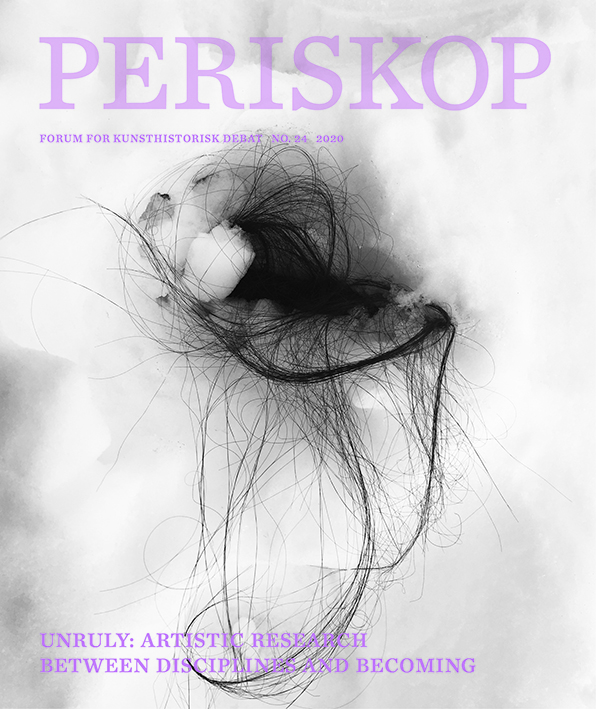
Imayna Caceres
Unruly: Artistic Research between Disciplines and Becoming.
Katrine Dirckinck-Holmfeld, Charlotte Hauch, Camilla Graff Junior, and
Lise Margrethe Jørgensen. Eds.
2020
Katrine Dirckinck-Holmfeld, Charlotte Hauch, Camilla Graff Junior, and
Lise Margrethe Jørgensen. Eds.
2020
"In Denmark, the discussion on artistic research has predominantly been about what artistic research is, and if its processes and practices can qualify as both a work of art and knowledge. With this special issue, we wish to instead ask how artistic research is being done and what potentials it holds for future critical practices in response to different contexts. And how are artistic research practices engaging in the co-creation of other worlds in response to different forms of social crises and planetary destruction?"
The findings were experienced as lessons gathered in the interaction with other-than-human beings, situations, and events. Once these teachings were materialized as thoughts, I searched for academic literature that I could weave myself into. I believe that academic discussion can no longer aspire to validity when the discussions about reality only happen between humans, in the absence of non-human agents of history that build reality along with us. And I see there is a change happening across different disciplines in regards to this. A growing awareness that all earth beings contribute to a history that is not solely human.
I reference my upbringing amid mestizo-Indigenous practices that stem from Amazonian and Andean worlds. I pay attention to the methods and teachings of other beings that reveal fundamental questions about the life we live. I incorporate what I’ve learned from the processes of life giving, depletion, care, and repair. And I am attentive to the ways in which other beings communicate, through dreams, visions, and spiritual experiences.
Those whom we care for teach us through their being, and we learn through witnessing what life needs to exist. What caring for new life has taught me is that in the cumbersome repetition of the tasks of care lays the self-knowledge of our existence.
This ritual acknowledgement of the function of others in my life is an important tool to question fetishist processes of alienation in capitalism, of deterritorialization, of the state sanctioned legal order, and an important tool for making communal sense.
Thanks to the editors who accepted my proposal as part of their open call.

Anti*Colonial Fantasies, Decolonial Strategies.
Imayna Caceres, Sunanda Mesquita, Sophie Utikal, Eds.
Published by Zaglossus Editorial.
2017
Anti*Colonial Fantasies / Decolonial Strategies brings together artists from different diasporas, students and lecturers, who engage with a critique of the repercussions of colonialism—including in academia—and the quest for transforming this reality. Working with various media—performances, videos, installations, paintings, photographs, drawings, and writing—as well as participatory formats, the artists expose ways in which colonialism persists today. Raising questions of race, sexuality, gender, spirituality, space, and time, they occupy themselves with the imagination and possibility of alternative realities and pursue decolonial strategies of resistance and knowledge production.
Anti*Colonial Fantasies is a student and lecturer initiative that is part of a history of decolonial, postcolonial, antiracist initiatives at the Academy of Fine Arts Vienna and within Austria. It belongs to a genealogy of artistic works produced by BPoC (Black and People of Color) and migrant artists that seek to transform the contexts and spaces they occupy. These interventions seek to address colonialism and racism from within the centers of hegemonic Eurocentric knowledge. The activist protagonists of this history of BPoC political actions are from different diasporas and move within the realm of arts where they affirm BPoC identity.
Contributors: Belinda Kazeem-Kamiński, Gerardo Montes de Oca, Imayna Caceres, Sunanda Mesquita, Verena Melgarejo Weinandt, Amoako Boafo, Stephanie Misa, Sandra Monterroso, Tatiana Nascimento, Ezgi Erol, Firas Shehadeh, Hansel Sato, Sophie Utikal, Rini Mitra, Mariel Rodríguez, Naomi Rincón Gallardo, Cana Bilir-Meier, Pêdra Costa, and Eduardo Triviño Cely.
Thanks to Jean Pierre Cueto who invited us to apply, and to Nicole de Fleurs of Zaglossus.
Imayna Caceres, Sunanda Mesquita, Sophie Utikal, Eds.
Published by Zaglossus Editorial.
2017
Anti*Colonial Fantasies / Decolonial Strategies brings together artists from different diasporas, students and lecturers, who engage with a critique of the repercussions of colonialism—including in academia—and the quest for transforming this reality. Working with various media—performances, videos, installations, paintings, photographs, drawings, and writing—as well as participatory formats, the artists expose ways in which colonialism persists today. Raising questions of race, sexuality, gender, spirituality, space, and time, they occupy themselves with the imagination and possibility of alternative realities and pursue decolonial strategies of resistance and knowledge production.
Anti*Colonial Fantasies is a student and lecturer initiative that is part of a history of decolonial, postcolonial, antiracist initiatives at the Academy of Fine Arts Vienna and within Austria. It belongs to a genealogy of artistic works produced by BPoC (Black and People of Color) and migrant artists that seek to transform the contexts and spaces they occupy. These interventions seek to address colonialism and racism from within the centers of hegemonic Eurocentric knowledge. The activist protagonists of this history of BPoC political actions are from different diasporas and move within the realm of arts where they affirm BPoC identity.
Contributors: Belinda Kazeem-Kamiński, Gerardo Montes de Oca, Imayna Caceres, Sunanda Mesquita, Verena Melgarejo Weinandt, Amoako Boafo, Stephanie Misa, Sandra Monterroso, Tatiana Nascimento, Ezgi Erol, Firas Shehadeh, Hansel Sato, Sophie Utikal, Rini Mitra, Mariel Rodríguez, Naomi Rincón Gallardo, Cana Bilir-Meier, Pêdra Costa, and Eduardo Triviño Cely.
Thanks to Jean Pierre Cueto who invited us to apply, and to Nicole de Fleurs of Zaglossus.


Curating as Anti-Racist Practice
Imayna Caceres, Sunanda Mesquita, Sophie Utikal
Natalie Bayer, Belinda Kazeem-Kamiński, Nora Sternfeld, editors
Published in German by De Gruyter / Die Angewandte
Published in English by Aalto University
2017
The anthology Curating as Anti-Racist Practice reflects upon museums and exhibitions from the perspective of postcolonial museology, and critical migration and regime research. Beyond critical analysis, this collection of texts is about collecting strategies and forms of action that make it possible to think of curating as anti-racist practice. Using as springboards the intersections between social battlefields and curatorial practices, as well as a focus on agency, this book examines the relationality of struggles for and against representation. Therefore, the focus is on discursive strategies of resistance, contact zones and approaches to re-appropriation.
With texts and artistic contributions by Kemi Bassene / Natalie Bayer, Mark Terkessidis / Belinda Kazeem-Kamiński / Imayna Caceres, Sunanda Mesquita, Sophie Utikal / Nuray Demir, Nanna Heidenreich / Silvina Der-Meguerditchian / Bonaventure Soh Bejeng Ndikung / Minna Henriksson / Thomas J. Lax / Verena Melgarejo Weinandt / Bahareh Sharifi, Sandrine Micossé-Aikins / Katharina Morawek / Naomi Rincon Gallardo / Nora Sternfeld / Third Space Helsinki (Marianne Niemelä, Christopher Wessels, Ahmed Al-Nawas) / Jelena Vesić U.A.
Thanks to Belinda Kazeem-Kamiński who invited us to contribute.

The Ritual issue : Art as Healing Practice
Parabol N° 9. Curated by Verena Melgarejo Weinandt & Imayna Caceres (Vienna / Berlin / Lima)
Special format: 40 ✕ 58 cm
2018
In curating this printed issue, we approached the artistic and theoretical reflections of two guiding figures: the Cuban-born artist Ana Mendieta and the Chicana author and artist Gloria Anzaldúa. For Anzaldúa, her job as an artist “is to bear witness to what haunts us, to step back and attempt to see the pattern in these events (personal and societal) and how we can repair el daño (the damage) by using the imagination and its vision.” In turn, for Mendieta, art’s greatest value is its spiritual role: “My art is grounded in the belief of one universal energy that runs through everything: from insect to man, from man to spectre, from spectre to plant, from plant to galaxy.”
We presented the works, exploring their connections between each other and the invocations they summon. The works invoke a stitching of wounds, of moving selves, and of spiritual activism. They refer to cosmovisions of interrelation, of trans and afro spiritualities, of Andean transformations, and indigenous reparations. They braid connections: caring for the dead in underworld journeys, exorcising whiteness with poisonous cures, and channeling communal spirits. They seek to activate ancestral knowledge and universal energies—a politics of the ritual towards healing revolutions. The invited artists share a deep preoccupation with the intersection of political, sexual, ecological, and spiritual realms. Their works push the association between third-world, racialized, gendered bodies and colonial history, political activism and ancestral references, sexual politics, and mystical sources.
Participating Artists: Vivian Zurita, Sergio Zevallos, Sophie Utikal, Mariel Rodríguez, Naomi Rincón Gallardo, Maque Pereyra, Antonio Paucar, Eliana Otta, Sandra Monterroso, Ana Mendieta, Verena Melgarejo Weinandt, Marissa Lôbo, Alfredo Ledesma, Alessandra Dos Santos, Pêdra Costa And Taís Lobo, Imayna Caceres, Gloria Anzaldúa.
Thanks to Verena Melgarejo Weinandt who invited me to co-curate, to Margarethe Makovec of < rotor > association for contemporary art who linked us to section a, and to the people of section a for the enthusiastic support. Thanks to the suggestions of Miguel López and Arturo Higa, and to Manuel Carreon Lopez of kunst-dokumentation.com.
More images from The Ritual Issue: https://www.sectiona.at/?pid=168
Bildpunkt N°46 Aus dem utopischen Halbdunkel
Heft Mai, Künstlerische position
2018
Wer braucht überhaupt Organisation – die Zivilgesellschaft oder die postsozialdemokratische Linke, das alternative Milieu, das Prekariat oder die Subalternen? Und welche – Netzwerk, Mosaik, Schwarm, oder doch Partei? Auch stellen sich Fragen der Organisierung im Kunstfeld strukturell anders als im politischen Feld. Nicht zuletzt angesichts des Regierungswechsels in Österreich und des Vormarsches ultrarechter Bewegungen und Parteien in ganz Europa stellt sich die Frage linker Organisierung neu. Während mit dem Aufbruch in Österreich der langen Reihe linker Organisierungsversuche ein weiterer hinzugefügt wurde, hat auch die Geschichte des künstlerischen Feld einige Zusammenrottungen um Programme, Mitglieder und Statuten zu bieten. Vor dem Hintergrund dieser historischen Differenzen und gegenwärtiger Entwicklungen stellt der Bildpunkt die Organisationsfrage(n), um sie nicht länger im „utopischen Halbdunkel“ zu belassen, wo Lukács sie noch sah. –Jens Kastner.
Auf dem Backcover ist eine Bleistiftzeichnung von Imayna Caceres abgebildet, die einen Ausschnitt ihrer Installation Condor, Puma, Serpiente (2018) zeigt. Die Arbeit ist eine Würdigung der und Annäherung an die Frauen ihrer Familie, die die Künstlerin, Kuratorin und Aktivistin mit peruanischer Herkunft, die seit mittlerweile 10 Jahren in Wien lebt, als Fundament ihrer eigenen sowie der kollektiven Geschichte begreift. Ihre Methode des Zeichnens, die sie beim Porträtieren ihrer Großmutter und ihrer Mutter gewählt hat, beschreibt Drei künstlerische Positionen begleiten jede Ausgabe des Bildpunkt und sind als eigenständige Kommentare und Reflexionen zum jeweiligen Thema des Heftes zu verstehen. Caceres sorgfältiges Verknüpfen und Verweben von Bleistiftstrichen, um, wie sie sagt, „die Wege nachzuzeichnen, die zu mir führen, die Schichten und Gewebe, die mich ausmachen, die Wurzeln, die mir Halt geben.“ Zeichnen stellt für sie eine Form der Annäherung, ein Werkzeug des Erinnerns dar – in Anbetracht einer Abwesenheit von Fotos oder Dokumenten, die von ihrer Vergangenheit erzählen könnten.
Thanks to Carlos Toledo who invited me to participate in this edition.
Bildpunkt N°31 EXITstrategien
Heft Frühling, Künstlerische position
Katherine Ball, Katarzyna Winiecka, Imayna Caceres and Refugee Protest Vienna
2014
Eine lange „Tradition der Migration“ machte die Feministin Gloria Anzaldúa 1987 in ihrem Buch Borderlands aus, die durch das Ziehen einer neuen Grenze ausgelöst worden sei. Konkret gemeint war der Grenzverlauf zwischen Mexiko und den USA. Nach dem Krieg zwischen den beiden Ländern wurden 1848 weite Teile des mexikanischen Nordens den USA zugeschlagen. Aber Anzaldúa verallgemeinert diese Situation: Jede Grenze erzeugt Bevölkerungsgruppen, die auf der „falschen“ Seite leben und schafft unterschiedliche Lebensbedingungen, die zum Ortswechsel verleiten. Wenn auch auf Gewalt und Zwang beruhend, so bieten solche Grenzräume laut Anzaldúa doch auch Möglichkeiten. Strategische Möglichkeiten, die auch den Umgang mit (immer fremdund selbstzugeschriebener) Zugehörigkeit betreffen. „Nothing happens in the ‚real’ world“, schreibt Anzaldúa, „unless it first happens in the images of our heads.“ Sich etwas klar- und sich ein Bild machen, Kognition und Kreation, rücken hier recht eng zusammen und werden zur selbstbestimmten Grundlage sozialen Wandels gemacht. Deshalb rückt auch die Bildproduktion dies- und jenseits des eigenen Kopfes ins Interesse sozialwissenschaftlicher wie politisch-aktivistischer Ansätze. –Jens Kastner.
Die Bildstrecke zeigt diverse icons, die von Katherine Ball, Katarzyna Winiecka und Imayna Caceres mit Refugee Protest Vienna entwickelt wurden. Sie wurden und werden als Teil von öffentlichen Installationen, als Poster und Flyer verwendet, und setzen mit Flucht verbundene Situationen, Instrumente, Gefahren ins Bild. So funktionieren sie als Interventionen in den öffentlichen Raum und prägnantes Kommunikationsmittel, um Forderungen der Refugee Bewegungen nicht nur in Wien Gewicht und Nachdruck zu verleihen. Solidarize with the Refugee Protest Vienna!
http://refugeecampvienna.noblogs.org
Thanks to Katarzyna Winiecka and Katherine Ball who asked me to take part.

Bleibeführer_in Wien
Guide for refugees and asylum seekers who stay to live in Vienna
Collective project
2012
A guide to make visible the network of support towards migrants and asylum seekers and to encourage resistance by gathering local, political, and cultural spaces, as well as testimonies on how to deal with social workers, police harassment or any other forms of institutionalized racism. Places where to sleep, legal and asylum support, governmental institutions, antiracist work organizations, counseling for women, queer spaces, healthcare centers for migrants, options for mobility, education, children, culture, and spaces for political organization. First edition: 1000 copies. Second edition: 1500 copies. The guide can be downloaded here and a search by districts can be made here. Initiated by Hansel Sato and Erinmwionghae Clifford in cooperation with Planet 10 in the frame of Wienwoche. Thanks to Hansel Sato who invited me to participate.

An Indigenous critique of the State
Utopia of alliances, conditions of impossibilities and the vocabulary of decoloniality.
Editorial Group for Writing Insurgent Genealogies
361 pp. Löcker Verlag
2013
A reflection of forms of anti-racist, anti-colonial, political, theoretical, critical and artistic works. In this book the concept of decoloniality is employed to rethink learning processes coming from positions that are not exclusively Western-oriented but are instead formed by other political-social contexts and perspectives.
Editorial Group for Writing Insurgent Genealogies
361 pp. Löcker Verlag
2013
A reflection of forms of anti-racist, anti-colonial, political, theoretical, critical and artistic works. In this book the concept of decoloniality is employed to rethink learning processes coming from positions that are not exclusively Western-oriented but are instead formed by other political-social contexts and perspectives.
I took the opportunity to have the protest of an unidentified Awajun-Wampi woman published in the book: in the Peruvian Amazon a series of protests against the extraction of oil, wood and gold in protected areas, is counteracted by the State and ends with a hundred civilians injured and the death of what is presented as murdered policemen and deceased natives. While the figure 'exploitation of natural resources – damage to the environment – protest – state repression' is a constant in Peru, the protest of the Amazonian peoples reveals the most salient aspects of the underlying continuities of a colonial system. State representatives refer to the protesters as terrorists who impede the progress of the country, or alternative as good people ("the natives are good") who are just being manipulated by forces who seek to destabilize the government. This denial of the Amazonian subject and/or of the Indigenous subject as a political subject, is questioned by the protest speech of an Awajun-Wampi woman who provides an analysis of the role of the State in her sense of reality. Thanks to the class of Post Conceptual Art Practices of the Academy of Fine Arts Vienna in which the book was produced between 2011-2013.
Upcoming Encounters
2026 Homotopia / Queercore. Mentor of artist, writer, curator Stephanie Trujillo. Liverpool based initiative. April-December.
06.2025 Liverpool Biennial https://www.biennial.com. Liverpool. Jun 7 - Sep 14.
06.2025 TQW Theory. Future Playground. Jun 13-14.
05.2025 Paper Launch. A is for Assembling. Body and Performance Practices. TQW Paper. TQW Studios, Vienna. May 27.
04.2025 Book Presentation. Stimmen des Antikolonialismus. Eine globalhistorische Spurensammlung 1615-1915. Mandelbaum Verlag. AK Bibliothek, Vienna. Apr 29.
06.2024 Sensing Resonance in Klima Bienniale Wien. Vienna. Jun 24-26.
06.2024 Rituals and music as political tools in MWD Sonic Dialogues: Intersections of Art and Sound in
Public Space. Vienna. Jun 12-14.
05.2024 La autohistoria teoría y otros métodos artísticos de investigación
04.2024 Navigating catastrophic times: The Planthroposcene, London. Apr 19.
03.2024 Dekolonialität und Kunst. Academy of Fine Arts, Vienna. Mar 15.
02.2024 Eco of Narcissus. Aural exhibition. Lima. Feb 6 - 27.
10.2023 El Futuro Ya Fue: Antifuturismo Cimarrón. La Virreina, Barcelona. Oct 12 - Jan 31.
06.2023 Dancing to Transform the World. Rotor Contemporary Art Graz. Jun 16 - Oct 21.
10. 2022 Earth Beings and Creatures. Rotor Contemporary Art Graz. 24 Jun - 15 Oct.
01. 2023 Mein Körper, ein Korallenriff? Wilhelm-Hack-Museums, Ludwigshafen. Jan 27 - Apr 23.
11. 2022 Soñar desde Afuera: Ficciones y Especulaciones. Galeria Brutal. Lima, 10 Nov.
10. 2022 Learning from plants, rocks and waters: Counterstories from earth beings amid global crisis.
Soho. 04 - 23 Oct.
09. 2022 Migrant Ecologies: Dwelling, and Mobility. Our connection to rivers. 20 Sep.
09. 2022 Women Networks, Feminist Movements, Politics of Solidarity. Kunsthalle Wien. 02 Sep.
Info für BIPOC (Black Indigenous People of Color), migrants and racialized artists in Austria
Inspired by our 2012 project Bleibeführer_in Wien
https://www.scribd.com/doc/109907326/Bleibefuehrer-in-Wien
*
—Fun/Culture
—Sports Exercise Dancing
https://www.scribd.com/doc/109907326/Bleibefuehrer-in-Wien
—Help with visa
http://helpinghands.at/
—German to study and to take tests
German Speaking Test B1
https://piramidops.com/
—Sprachcafes
https://wienxtra.at/informationen/infos-a-z/info/sprachcafes/
https://www.nachbarschaftszentren.at/kontaktepool-wien/sprachencaf%C3%A9
https://wienxtra.at/informationen/infos-a-z/info/sprachcafes/
https://www.nachbarschaftszentren.at/kontaktepool-wien/sprachencaf%C3%A9
https://buechereien.wien.gv.at/B%C3%BCchereien-Wien/Angebote/Interkulturelles/Deutsch-lernen
https://www.wu.ac.at/lrc/sprachenlernen/language-cafe
—Translators
https://www.culturalatina.at/de/service/beglaubigte-uebersetzungen
https://www.universitas.org/de/experten-universitas/?ul=de&l1=Spanisch&l2=Deutsch&t=&u=1&ln=&bw=&fb=
—Taxes
https://www.hapala-steuerberatung.at
—Antiracist Support
https://www.oehakbild.info/category/die-oh/antira/
https://oeh.univie.ac.at/referate/antirassistische-arbeit
https://oeh.univie.ac.at/referate/antirassistische-arbeit
https://www.zara.or.at/de
*
—Job Offers
https://www.mqw.at/institutionen/q21/artists-in-residence/
—Job Offers
Whatsapp Group
—Open calls for exhibitions, scholarships, etc
https://www.instagram.com/artopencalls/
https://www.instagram.com/opencallforartists/
https://kueltuergemma.at
—Open calls for exhibitions, scholarships, etc
https://www.instagram.com/artopencalls/
https://www.instagram.com/opencallforartists/
https://kueltuergemma.at
—Unions, Collectives, Art associations for migrants
https://igbildendekunst.at
https://www.d-arts.at
https://sohostudios.at https://www.mqw.at/institutionen/q21/artists-in-residence/
https://www.maiz.at/
—Fun/Culture
https://www.queerzilla.org/
https://kaleidoskop.film
https://www.gogogo.at/kinoamdach
https://kultursommer.wien
https://filmfestival-rathausplatz.at
https://donauinselfest.at
—Media
https://okto.tv
http://migrazine.at
—Affordable shopping and food
https://okto.tv
http://migrazine.at
*
—Resources for care. Molecularly, through the body. Relating to plants based nurturing, spiritual, mental and planetary balance. Talks on health and food Sources of Nutrients.—Health BPOC Doctors
https://www.docfinder.at
https://www.docfinder.at
—Affordable shopping and food
https://dieschenke.wordpress.com
https://www.instagram.com/dieschenke_geldlos/
https://www.willhaben.at/
http://www.sozialmarkt.com
http://deewan.at
http://deewan.at
—Meeting Places
https://www.planet10wien.at
https://www.wuk.at
https://dievilla.at
https://www.wuk.at
https://dievilla.at
Yoga for Bipocs
http://www.criticalmass.at/about/
—Flinta Queer Support
https://oeh.univie.ac.at/referate/queer-referat
https://dievilla.at

b. Callao, Peru. She-they.
I engage in my work, my experience with modes of being in the worlds I am related to in Peru and Austria (particularly growing up in urban areas of the desertic central coast, inheriting practices from the oriental tropical Andes and daily interactions in the Nordbahnhofgelände in Vienna to the beings which inhabit these areas).
In my latest projects I work with notions of vital knowledges. I have worked in previous projects with the reverberations of the work of Gloria Anzaldúa, decolonial strategies and anticolonial fantasies in the etnographic museum and in the art academy, and critical perspectives on colonialism and migration. As well as with the worlds of the underground, of roots and of darkness, and the teachings of plants.
I am a candidate for the philosophy doctorate at the Academy of Fine Arts Vienna. MA. in Fine Arts, MA. in Kunst- und Kulturwissenschaft from the Academy of Fine Arts Vienna and a graduate of Sociology from the PUCP University of Peru and of Communications Sciences from the University of Lima.
I am part of the collectives Antikoloniale Interventionen in Wien and Bloco Feministische Decolonial.
↠ imayna.caceres at gmail.com
BPOC Films Collection and more
LIST OF FILMS WITH A POC LEAD
35 Shots of Rum by Claire Denis (2008) intimate family study. 97% rotten tomatoes
Alice in Earnestland
Amreeka (2009)
Mona, a Palestinian woman moves to America to start a new life with her son Faddy. But life isn’t easy in post-9/11 America as anti-Arab sentiments rise. Mona and Faddy make new friends, enemies, and a new life for themselves in Illinois. Warmth and humour whilst dealing with very serious themes: war, racism, migration and cultural identity.
Akeelah and the Bee (2006)
A black girls path to win a spelling contest.
Anita (Documentary, Dir. Freida Lee Mock) 76%Anita and Me (2002)
"A Different Image" by Alile Sharon Larkin (1982)
An African American woman living away from her family in Los Angeles yearns to be recognized for more than her physical attributes. In cultivating the friendship of a male office mate, she aspires to a relationship where romance is not a factor, seeking someone who can "see her as she is," rather than see only what he wants to see.
"A Girl Walks Home Alone at Night" by Ana Lily Amirpour (2014)
Audre Lorde, 1934-1992
"Advantageous" by Jennifer Phang (2015) 8.0
In a near-future city where soaring opulence overshadows economic hardship, Gwen and her daughter Jules do all they can to hold on to their joy together, despite the instability surfacing in their world.
"Ala Modalaindi" by Nandini Bv Reddy (2011)
"All About You" by Christine Swanson (2001)
"Alma's Rainbow" by Ayoka Chenzira (1994)
"Appropriate Behavior" by Desiree Akhavan (2014)
“Arranged” (2007)
An Orthodox Muslim woman and an Orthodox Jewish woman befriend each other when they are assigned to teach the same class. They realize they both have a lot in common in terms of their cultural and relationship experiences, the way they practice their faith, and the type of stereotyping and scrutiny they face by others.
"B For Boy" by Chika Anadu (2013)
"Bande de Filles/Girlhood" by Céline Sciamma (2014)
"Belle" by Amma Asante (2013)
Based on history, this film follows Dido Belle, the mixed-raced daughter of a British admiral. Dido is raised by her aristocratic great-uncle, who is also Lord Chief Justice of England. While her lineage gives her certain privileges in society, Dido faces prejudices and limitations based on the colour of her skin and her gender. Set at a historic moment, just before the abolition of slavery, this must-see film explores the interplay of class, race and gender within the British aristocracy during the late 1700s.
Beauty Shop: Queen Latifah
"Bend it Like Beckham" by Gurinder Chadha (2002) hollywood like
Set in London, England, Jess is the daughter of Orthodox Punjabi Sikh parents. Her parents prefer she learn how to make the perfect chapati and cook daal, but Jess would rather play professional football (soccer). She secretly joins a football team, her heart set on pursuing her passion. Adventurous and empowering comedy.
"Bessie" by Dee Rees (2015)
"Beyond the Lights" by Gina Prince-Bythewood (2014) Nate Parker
Born in Flames
"Bhaji on the Beach" by Gurinder Chadha (1993)
"Caramel" by Nadine Labaki (2007)
"Circumstance" by Maryam Keshavarz (2011)
"Civil Brand" by Neema Barnette (2002)
"Compensation" by Zeinabu irene Davis (1999)
"Coonskin" (1975)
animated crime drama to screens to a lot of controversy back in 1975. A satire of mob films, racist stereotypes, and Songs of The South, Coonskin not only challenged what we could and should expect from animation, its bold and brazen depiction of race relations in America (the country is here represented by a blonde woman who seduces and kills African-American men) is unlike anything you’ve ever seen this generation or otherwise.
"Daughters of the Dust" by Julie Dash (1991)
"Double Happiness " by Mina Shum (1994)
"Down in the Delta" by Maya Angelou (1998)
"Drylongso" by Cauleen Smith (1988)
"Earth" by Deepa Mehta (1998)
"Elza" by Mariette Monpierre (2011)
Empire of Dirt (2013)
Lena, a First Nations mother, flees her hometown after her 13 year old daughter gets in trouble. Lena reunites with her mother, and the three women try to bridge the generation gap and face demons from their past. It’s a beautiful, critically acclaimed Canadian film about motherhood, family, overcoming cycles of trauma, and healing.
"Endless Dreams" by Susan Youssef (2009
"Eve's Bayou" by Kasi Lemmons (1997)
"Fire" by Deepa Mehta (1996)
"Frida" by Julie Taymor (2002) Hollywood (would like to watch again)
"Girl in Progress" by Patricia Riggen (2012)
"Girlfight" by Karyn Kusama (2000)
Gotta Kick it Up
Hallelujah (1935) https://www.youtube.com/watch?v=mcSrnkwiwEM
"Habibi Rasak Kharban" by Susan Youssef (2011)
"Hiss Dokhtarha Faryad Nemizanand (Hush! Girls Don't Scream)" by Pouran Derahkandeh (2013)
"Honeytrap" by Rebecca Johnson (2014)
"I Like It Like That" by Darnell Martin (1994)
"I Will Follow" by Ava DuVernay (2010
Imitation of Life (1934) – Netflix. Two female leads, the WOC performs the housekeeper
Imitation of Life –1959 (Douglas Sirk)
"In Between Days" by So-yong Kim (2006)
"Introducing Dorothy Dandridge" by Martha Coolidge (1999)
"It's a Wonderful Afterlife" by Gurinder Chadha (2010)
"Jumpin Jack Flash" by Penny Marshall (1986)
"Just Another Girl on the IRT" by Leslie Harris (1992)
"Just Wright" by Sanaa Hamri (2010)
"Kama Sutra" by Mira Nair (1996)
"Losing Ground" by Kathleen Collins (1982)
"Love & Basketball" by Gina Prince-Bythewood (2000)
"Luck by Chance" by Zoya Akhtar (2009)
Marry Me – 2010
light-hearted Hollywood rom-com. Lucy Lui plays Rae Ann Carter, a social worker who dreams of becoming an artist and getting married. She goes from having no one interested in her to three men romantically pursuing her. She must figure out what and who she wants. On top of all of that, Rae has a snarky and mischievous foster kid on her hands, Imogen, for whom she must find a suitable foster family. This film is especially worth watching for the friendship that develops between Rae and Imogen. While the marriage plot can get a bit tiring, what I liked most about this film was the chemistry between the cast, the witty banter, snappy dialogue, clever writing and strong acting.
"Mi Vida Loca" by Allison Anders (1993)
"Middle of Nowhere" by Ava DuVernay (2012)
"Mississippi Damned" by Tina Mabry (2009)
"Mississippi Masala" by Mira Nair (1991)
"Mixing Nia" by Alison Swan (1998)
"Monsoon Wedding" by Mira Nair (2001)
"Mosquita y Mari" by Aurora Guerrero (2012)
"Na-moo-eobs-neun san (Treeless Mountain)" by So-yong Kim (2008)
"Night Catches Us" by Tanya Hamilton (2010)
"Pariah" by Dee Rees (2011)
Patient (Paciente) Jorge Caballero Colombia. middle-aged woman cares for her cancer-stricken 23-y.o. daughter. unsentimental and briskly economic, a textbook example of how horrendously difficult and sensitive material can and should be handled.
"Picture Bride" by Kayo Hatta (1994)
"Rain" by Maria Govan (2008)
"Real Women Have Curves" by Patricia Cardoso (2002)
"Saving Face" by Alice Wu (2004) WOC
A romantic comedy about a Chinese-American mother and daughter who struggle to face the consequences of life choices they have made. Wil is a lesbian who’s afraid of coming out to her traditional mother and being publicly open about her relationship. Much to Wil’s surprise, her mother Gao soon shows up on her doorstep, pregnant out of wedlock. Both must learn to accept themselves as well as each other.
"Second Coming" by Debbie Tucker Green (2014)
“Selena”
Jennifer Lopez stars in this biographical film about the late Mexican-American singer, Selena. It follows her life and career as she shoots to fame and the struggles she faces along the way. Selena was Jennifer Lopez’s breakthrough film role and also inspired her singing career.
Slaying the Dragon: Reloaded (2011)
problematic representations of Asian women in Hollywood
"Something Necessary" by Judy Kibinge (2013)
"Something New" by Sanaa Hamri (2006)
Sonita
Rokhsareh Ghaem Maghami's documentary on a teenage Tehran rapper was a wide-margin winner of the audience award at the Dutch festival.
Sepideh
"Still the Water" by Naomi Kawase (2014)
"Stranger Inside" by Cheryl Dunye (2001)
"Sugar Cane Alley/Black Shack Alley" by Euzhan Palcy (1983)
'The Bravest, The Boldest' –2014. A young mother in a Harlem housing project realizes the arrival of two uniformed soldiers brings news she can't bring herself to accept.
The Color Purple (1985)
"The Kite" by Randa Chahal Sabag (2003)
The Ladies No. 1 Detective Agency. (2009) TV series Botswana Female detective.
"The Rich Man's Wife" by Amy Holden Jones (1996)
The Sapphires 2012
Black women band in Australia
"The Secret Life of Bees" by Gina Prince-Bythewood (2008)
"The Silence of the Palace" by Moufida Tlatli (1994)
The Stuart Hall Project / Akomfrah, John [Regie] / Künstl.Lehramt-Bibliothek IKL( 1/ 0)
"The Watermelon Woman" by Cheryl Dunye (1996) WOC
IndieFlix #SistahSinema: https://indieflix.com/indie-films/the-watermelon-woman-41943/
"The Women of Brewster Place" by Donna Deitch (1989)
"Their Eyes Were Watching God" by Darnell Martin (2005)
"Things We Lost in the Fire" by Susanne Bier (2007)
"Wadjda" by Haifaa Al-Mansour (2012) netflix
Wadjdah is a rebellious Saudi girl who longs to possess a green bike that she spots in a store. She wants to race against her friend Abdullah who already owns a bike. Her mother refuses to buy the bike because it is frowned upon girls to ride bikes. Wadjdah must figure out a way to raise enough money to buy it herself. She decides to enrol in a Quran competition and use the winnings toward the bike. Wadjdah is the first feature-length film made by a female Saudi director and has won numerous film awards.
"Water" by Deepa Mehta (2005)
"Whale Rider" by Niki Caro (2002)
"What's Cooking?" by Gurinder Chadha (2000)
"Where Do We Go Now?" by Nadine Labaki (2011)
"Whitney" by Angela Bassett (2015)
"Woman Thou Art Loosed: On The 7th Day" by Neema Barnette (2012)
"Xiu Xiu: The Sent-Down Girl" by Joan Chen (1998)
"Yelling to the Sky" by Victoria Mahoney (2011)
"Young and Wild" by Marialy Rivas (2012)
courtesy of Ava DuVernay
SILENT BPOC FILMS
Body and Soul (1925)
Silent film produced, written, directed, and distributed by Oscar Micheaux and starring Paul Robeson in 1925. When the filmmaker applied for an exhibition license from the Motion Picture Commission of the State of New York, it was denied approval on the grounds it would "tend to incite to crime" and was "immoral" and "sacrilegious". He re-edit the film twice before the commission approved it. Body and Soul is one of three surviving silent films created by Micheaux, who is credited with making 26 silent productions. It was originally released to cinemas catering to an exclusive African American audience, and for many years the film was unknown to white moviegoers.
HOLLYWOOD ON RACE
Hallelujah!
Judge Priest
Imitation of Life
God’s Step Children
The Duke Is Tops
Gone With the Wind
The Blood of Jesus
The Jackie Robinson Story
Native Son
Carmen Jones
The Defiant Ones
In the Heat of the Night
Sweet Sweetback’s Baad Asssss Song
Lady Sings the Blues
Cooley High
Killer of Sheep
A Soldier’s Story
Do the Right Thing
Boyz N the Hood
Eve’s Bayou
Bamboozled
Madea’s Family Reunion
Mississippi Burning
I Am Legend
Roots
Ruby Bridges
To Kill A Mocking Bird
INTERRACIAL ROMANCE
Our Family Wedding
Unbowed (1999) Amerindian / Black love story
A Patch of Blue (1965) 8/10
A blind, uneducated white girl is befriended by a black man, who becomes determined to help her escape her impoverished and abusive home life. (105 mins.)
INDIGENOUS
Smoke Signals. Amerindian
North of 60. Amerindian
Pathfinder, a 2007 movie about Vikings' battling Native Americans in the New World.
Rez Bomb, director Steven Lewis Simpson, at native Pine Ridge Indian Reservation
Reel Injun. disassembles tropes such as the “White Messiah” (Dances with Wolves) and the “Groovy Indian” (perpetuated by Cher in “Half Breed”), and features films that truly amplifies Aboriginal voices, like Atanarjuat: the Fast Runner. Stereotypes not only run rampant in the present, but in the past were combined with the fact that white actors were dressed up and put in brown-face to play the parts of Native actors. Aside from being offensive and untrue, this was effectively wiping representation of Aboriginal people completely from mass media and popular culture.
Kon-Tiki Expedition: By Raft Across the South Seas. A documentary film of the Norwegian expedition won an Academy Award in 1951. In 2012, a dramatised version was released and was nominated for Best Foreign Language Oscar and Best Foreign Language Golden Globe Award.
DECOLONIAL FROM LATIN AMERICA
El Abrazo de la Serpiente (The embrace of the Serpent) 2015. Colombian filmmaker.
Indigenous cosmovisions and the impact of colonialism on indigenous peoples.
Libertador aka Liberator (2013, Alberto Arvelo, Venezuela)
The story of the historical South American liberator, Simón Bolivar, played by Venezuelan actor Edgar Ramírez. Since his childhood among the different social classes in Venezuela until the betrayal that led to his execution.
Río de Oro aka Gold River (2010, Pablo Aldrete, Mexico)
The story of the war between Mexico and the United States, a war that left the apaches, the landowners and the farmers in the middle of a bloodbath produced by the American army. Trinidad has lost his family in this war and prepares to go to the South in search of gold. Estela is a woman who has also lost her family, and has been kidnapped by an apache named Goyahkla.
The war, the Navajo tribe, and the people living on the frontier during this conflict on the Sonoran desert.
Eco de la montaña aka Echo of the Mountain (2014, Nicolás Echevarría, Mexico)
In the Sierra Madre of Mexico, an extended mountain range that goes all over the country, there’s a community of natives named huicholes. The culture of the huichol is rich in art and traditions. This documentary shows us the unjust but wonderful life of this wixárika named Motoapohua which literally means Echo of the Mountain.
Los viajes del viento aka The Wind Journeys (2009, Ciro Guerra, Colombia) 85%
Telling the story of an old legend that guided us into the history of the vallenato, a popular Colombian music genre that mainly features the accordion, alongside other native instruments, which provides it with its particular Caribbean sound. The story goes about the journey of Ignacio, an old juglar (minstrel) who wants to give his old master back the accordion he possesses, and legend has it that this accordion once belonged to the devil. In his journey, the young Fermín joins him, wanting Ignacio to teach him how to be a good musician. So they travel to the depths of the most unknown places in the Colombian Caribbean until they reach the distant Guajira desert.
Cabeza de Vaca (1991, Nicolás Echevarría, Mexico) 75%
The conquest of Latin America
TV SERIES
Into the West (2005) (Wheel to the Stars) By DreamWorks. The characters speak in indigenous languages, which are translated in subtitles - but the tribute to the Lakota turns out to be mostly stifling. Most of the tribal conversation consists of dire predictions of doom at the hands of the white invaders; the individual personalities remain as noble and static as the chief in the 1971 anti-pollution ad featuring the "crying Indian." Charles Crocker cut off food and other supplies. After eight days of increasing privation, Crocker confronted the starving workers, along with James Strobridge, the local Sheriff and a contingent of deputized white men, insisting that he would make no concessions and threatened violence to anyone preventing workers from returning to the job. Facing starvation and coercion, the workers ended the strike. Charles Crocker became convinced that the labor action was a plot by the Union Pacific, which aimed to sabotage the Central Pacific’s forward progress in their race to gain more miles for subsidies. He never considered that the Chinese workers were capable of asserting their own interests. Instead of the Wheelers’ boldly representing a classic strain of American avariciousness, their desire for wealth is treated as a kind of random pestilence — a social disease that periodically ravages Native Americans and whites alike.
http://www.seattletimes.com/entertainment/noble-intentions-cant-save-spielbergs-into-the-west/
TRANSGENDER LEADS
Tangerine 2015 netflix
Two working trans women, Sin-Dee Rella (Kitana Kiki Rodriguez) and Alexandra (Mya Taylor), through the seedy streets of Los Angeles as they try to track down their absentee pimp, Chester (James Ransone), on Christmas Eve. Foul and funny, Baker’s film blurs the line between documentary and fiction in his revolutionary depiction of both prostitution and being trans in a modern day Tinseltown.
REVOLUTION
Home (2009 Documentary) 8.6/10
With aerial footage from fifty-four countries, 'Home' is a depiction of how Earth's problems are all interlinked. (120 mins.)
La muerte de un burócrata (1966) 7.8/10
A young man attempts to fight the system in an entertaining account of bureaucracy amok and the tyranny of red tape. (85 mins.) Director: Tomás Gutiérrez Alea
One of the best Cuban films ever made. Great laughs. Relevant for anyone to view.
Mary and Max (2009) 8.2/10
A tale of friendship between two unlikely pen pals: Mary, a lonely, eight-year-old girl living in the suburbs of Melbourne, and Max, a forty-four-year old, severely obese man living in New York. (92 mins.)
The Strange Case of Señor Computer (2000) 7.2/10
A lonely computer wiz creates a robot with human-like intelligence. They will influence and teach each other as their lives spin out of control. (91 mins.)
Viva Zapata! (1952) 7.5/10 brown face of marlon brando
The story of Mexican revolutionary Emiliano Zapata, who led a rebellion against the corrupt, oppressive dictatorship of president Porfirio Diaz in the early 20th century. (113 mins.) Director: Elia Kazan
Obvious Child (Comedy, Dir. Gillian Robespierre) 89%
The Girl with the Dragon Tattoo (2009) 86%
Scandal 91%
DOCUMENTARIES
Intangible Asset Number 82 (2008 Documentary) 8.4/10
The search for an enigmatic South Korean shaman, and the inspiration found on the journey, renews a jazz musician's faith in the power of music. (90 mins.)
Price of Gold (2012 Documentary) 7.4/10
Mongolia is known for its original Nomad culture as well as the spectacular natural landscape. Since gold deposits have been discovered however... (87 mins.)
Thrive (2011 Documentary) 6.7/10
An unconventional documentary that lifts the veil on what's really going on in our world by following the money upstream... (132 mins.)
The Wild Parrots of Telegraph Hill (2003 Documentary) 7.9/10
A homeless musician finds meaning to his life when he starts a friendship with dozens of parrots. (83 mins.) “ A charming, upbeat look inside the world of wild Peruvian and Argentinian parrots living in San Francisco -- and the man who cares for them.”
Pickup on South Street (1953) 7.8/10
A pickpocket unwittingly lifts a message destined for enemy agents and becomes a target for a Communist spy ring. (80 mins.)
Originally collected and published 24/7/ 2016 08:52
35 Shots of Rum by Claire Denis (2008) intimate family study. 97% rotten tomatoes
Alice in Earnestland
Amreeka (2009)
Mona, a Palestinian woman moves to America to start a new life with her son Faddy. But life isn’t easy in post-9/11 America as anti-Arab sentiments rise. Mona and Faddy make new friends, enemies, and a new life for themselves in Illinois. Warmth and humour whilst dealing with very serious themes: war, racism, migration and cultural identity.
Akeelah and the Bee (2006)
A black girls path to win a spelling contest.
Anita (Documentary, Dir. Freida Lee Mock) 76%Anita and Me (2002)
"A Different Image" by Alile Sharon Larkin (1982)
An African American woman living away from her family in Los Angeles yearns to be recognized for more than her physical attributes. In cultivating the friendship of a male office mate, she aspires to a relationship where romance is not a factor, seeking someone who can "see her as she is," rather than see only what he wants to see.
"A Girl Walks Home Alone at Night" by Ana Lily Amirpour (2014)
Audre Lorde, 1934-1992
"Advantageous" by Jennifer Phang (2015) 8.0
In a near-future city where soaring opulence overshadows economic hardship, Gwen and her daughter Jules do all they can to hold on to their joy together, despite the instability surfacing in their world.
"Ala Modalaindi" by Nandini Bv Reddy (2011)
"All About You" by Christine Swanson (2001)
"Alma's Rainbow" by Ayoka Chenzira (1994)
"Appropriate Behavior" by Desiree Akhavan (2014)
“Arranged” (2007)
An Orthodox Muslim woman and an Orthodox Jewish woman befriend each other when they are assigned to teach the same class. They realize they both have a lot in common in terms of their cultural and relationship experiences, the way they practice their faith, and the type of stereotyping and scrutiny they face by others.
"B For Boy" by Chika Anadu (2013)
"Bande de Filles/Girlhood" by Céline Sciamma (2014)
"Belle" by Amma Asante (2013)
Based on history, this film follows Dido Belle, the mixed-raced daughter of a British admiral. Dido is raised by her aristocratic great-uncle, who is also Lord Chief Justice of England. While her lineage gives her certain privileges in society, Dido faces prejudices and limitations based on the colour of her skin and her gender. Set at a historic moment, just before the abolition of slavery, this must-see film explores the interplay of class, race and gender within the British aristocracy during the late 1700s.
Beauty Shop: Queen Latifah
"Bend it Like Beckham" by Gurinder Chadha (2002) hollywood like
Set in London, England, Jess is the daughter of Orthodox Punjabi Sikh parents. Her parents prefer she learn how to make the perfect chapati and cook daal, but Jess would rather play professional football (soccer). She secretly joins a football team, her heart set on pursuing her passion. Adventurous and empowering comedy.
"Bessie" by Dee Rees (2015)
"Beyond the Lights" by Gina Prince-Bythewood (2014) Nate Parker
Born in Flames
"Bhaji on the Beach" by Gurinder Chadha (1993)
"Caramel" by Nadine Labaki (2007)
"Circumstance" by Maryam Keshavarz (2011)
"Civil Brand" by Neema Barnette (2002)
"Compensation" by Zeinabu irene Davis (1999)
"Coonskin" (1975)
animated crime drama to screens to a lot of controversy back in 1975. A satire of mob films, racist stereotypes, and Songs of The South, Coonskin not only challenged what we could and should expect from animation, its bold and brazen depiction of race relations in America (the country is here represented by a blonde woman who seduces and kills African-American men) is unlike anything you’ve ever seen this generation or otherwise.
"Daughters of the Dust" by Julie Dash (1991)
"Double Happiness " by Mina Shum (1994)
"Down in the Delta" by Maya Angelou (1998)
"Drylongso" by Cauleen Smith (1988)
"Earth" by Deepa Mehta (1998)
"Elza" by Mariette Monpierre (2011)
Empire of Dirt (2013)
Lena, a First Nations mother, flees her hometown after her 13 year old daughter gets in trouble. Lena reunites with her mother, and the three women try to bridge the generation gap and face demons from their past. It’s a beautiful, critically acclaimed Canadian film about motherhood, family, overcoming cycles of trauma, and healing.
"Endless Dreams" by Susan Youssef (2009
"Eve's Bayou" by Kasi Lemmons (1997)
"Fire" by Deepa Mehta (1996)
"Frida" by Julie Taymor (2002) Hollywood (would like to watch again)
"Girl in Progress" by Patricia Riggen (2012)
"Girlfight" by Karyn Kusama (2000)
Gotta Kick it Up
Hallelujah (1935) https://www.youtube.com/watch?v=mcSrnkwiwEM
"Habibi Rasak Kharban" by Susan Youssef (2011)
"Hiss Dokhtarha Faryad Nemizanand (Hush! Girls Don't Scream)" by Pouran Derahkandeh (2013)
"Honeytrap" by Rebecca Johnson (2014)
"I Like It Like That" by Darnell Martin (1994)
"I Will Follow" by Ava DuVernay (2010
Imitation of Life (1934) – Netflix. Two female leads, the WOC performs the housekeeper
Imitation of Life –1959 (Douglas Sirk)
"In Between Days" by So-yong Kim (2006)
"Introducing Dorothy Dandridge" by Martha Coolidge (1999)
"It's a Wonderful Afterlife" by Gurinder Chadha (2010)
"Jumpin Jack Flash" by Penny Marshall (1986)
"Just Another Girl on the IRT" by Leslie Harris (1992)
"Just Wright" by Sanaa Hamri (2010)
"Kama Sutra" by Mira Nair (1996)
"Losing Ground" by Kathleen Collins (1982)
"Love & Basketball" by Gina Prince-Bythewood (2000)
"Luck by Chance" by Zoya Akhtar (2009)
Marry Me – 2010
light-hearted Hollywood rom-com. Lucy Lui plays Rae Ann Carter, a social worker who dreams of becoming an artist and getting married. She goes from having no one interested in her to three men romantically pursuing her. She must figure out what and who she wants. On top of all of that, Rae has a snarky and mischievous foster kid on her hands, Imogen, for whom she must find a suitable foster family. This film is especially worth watching for the friendship that develops between Rae and Imogen. While the marriage plot can get a bit tiring, what I liked most about this film was the chemistry between the cast, the witty banter, snappy dialogue, clever writing and strong acting.
"Mi Vida Loca" by Allison Anders (1993)
"Middle of Nowhere" by Ava DuVernay (2012)
"Mississippi Damned" by Tina Mabry (2009)
"Mississippi Masala" by Mira Nair (1991)
"Mixing Nia" by Alison Swan (1998)
"Monsoon Wedding" by Mira Nair (2001)
"Mosquita y Mari" by Aurora Guerrero (2012)
"Na-moo-eobs-neun san (Treeless Mountain)" by So-yong Kim (2008)
"Night Catches Us" by Tanya Hamilton (2010)
"Pariah" by Dee Rees (2011)
Patient (Paciente) Jorge Caballero Colombia. middle-aged woman cares for her cancer-stricken 23-y.o. daughter. unsentimental and briskly economic, a textbook example of how horrendously difficult and sensitive material can and should be handled.
"Picture Bride" by Kayo Hatta (1994)
"Rain" by Maria Govan (2008)
"Real Women Have Curves" by Patricia Cardoso (2002)
"Saving Face" by Alice Wu (2004) WOC
A romantic comedy about a Chinese-American mother and daughter who struggle to face the consequences of life choices they have made. Wil is a lesbian who’s afraid of coming out to her traditional mother and being publicly open about her relationship. Much to Wil’s surprise, her mother Gao soon shows up on her doorstep, pregnant out of wedlock. Both must learn to accept themselves as well as each other.
"Second Coming" by Debbie Tucker Green (2014)
“Selena”
Jennifer Lopez stars in this biographical film about the late Mexican-American singer, Selena. It follows her life and career as she shoots to fame and the struggles she faces along the way. Selena was Jennifer Lopez’s breakthrough film role and also inspired her singing career.
Slaying the Dragon: Reloaded (2011)
problematic representations of Asian women in Hollywood
"Something Necessary" by Judy Kibinge (2013)
"Something New" by Sanaa Hamri (2006)
Sonita
Rokhsareh Ghaem Maghami's documentary on a teenage Tehran rapper was a wide-margin winner of the audience award at the Dutch festival.
Sepideh
"Still the Water" by Naomi Kawase (2014)
"Stranger Inside" by Cheryl Dunye (2001)
"Sugar Cane Alley/Black Shack Alley" by Euzhan Palcy (1983)
'The Bravest, The Boldest' –2014. A young mother in a Harlem housing project realizes the arrival of two uniformed soldiers brings news she can't bring herself to accept.
The Color Purple (1985)
"The Kite" by Randa Chahal Sabag (2003)
The Ladies No. 1 Detective Agency. (2009) TV series Botswana Female detective.
"The Rich Man's Wife" by Amy Holden Jones (1996)
The Sapphires 2012
Black women band in Australia
"The Secret Life of Bees" by Gina Prince-Bythewood (2008)
"The Silence of the Palace" by Moufida Tlatli (1994)
The Stuart Hall Project / Akomfrah, John [Regie] / Künstl.Lehramt-Bibliothek IKL( 1/ 0)
"The Watermelon Woman" by Cheryl Dunye (1996) WOC
IndieFlix #SistahSinema: https://indieflix.com/indie-films/the-watermelon-woman-41943/
"The Women of Brewster Place" by Donna Deitch (1989)
"Their Eyes Were Watching God" by Darnell Martin (2005)
"Things We Lost in the Fire" by Susanne Bier (2007)
"Wadjda" by Haifaa Al-Mansour (2012) netflix
Wadjdah is a rebellious Saudi girl who longs to possess a green bike that she spots in a store. She wants to race against her friend Abdullah who already owns a bike. Her mother refuses to buy the bike because it is frowned upon girls to ride bikes. Wadjdah must figure out a way to raise enough money to buy it herself. She decides to enrol in a Quran competition and use the winnings toward the bike. Wadjdah is the first feature-length film made by a female Saudi director and has won numerous film awards.
"Water" by Deepa Mehta (2005)
"Whale Rider" by Niki Caro (2002)
"What's Cooking?" by Gurinder Chadha (2000)
"Where Do We Go Now?" by Nadine Labaki (2011)
"Whitney" by Angela Bassett (2015)
"Woman Thou Art Loosed: On The 7th Day" by Neema Barnette (2012)
"Xiu Xiu: The Sent-Down Girl" by Joan Chen (1998)
"Yelling to the Sky" by Victoria Mahoney (2011)
"Young and Wild" by Marialy Rivas (2012)
courtesy of Ava DuVernay
SILENT BPOC FILMS
Body and Soul (1925)
Silent film produced, written, directed, and distributed by Oscar Micheaux and starring Paul Robeson in 1925. When the filmmaker applied for an exhibition license from the Motion Picture Commission of the State of New York, it was denied approval on the grounds it would "tend to incite to crime" and was "immoral" and "sacrilegious". He re-edit the film twice before the commission approved it. Body and Soul is one of three surviving silent films created by Micheaux, who is credited with making 26 silent productions. It was originally released to cinemas catering to an exclusive African American audience, and for many years the film was unknown to white moviegoers.
HOLLYWOOD ON RACE
Hallelujah!
Judge Priest
Imitation of Life
God’s Step Children
The Duke Is Tops
Gone With the Wind
The Blood of Jesus
The Jackie Robinson Story
Native Son
Carmen Jones
The Defiant Ones
In the Heat of the Night
Sweet Sweetback’s Baad Asssss Song
Lady Sings the Blues
Cooley High
Killer of Sheep
A Soldier’s Story
Do the Right Thing
Boyz N the Hood
Eve’s Bayou
Bamboozled
Madea’s Family Reunion
Mississippi Burning
I Am Legend
Roots
Ruby Bridges
To Kill A Mocking Bird
INTERRACIAL ROMANCE
Our Family Wedding
Unbowed (1999) Amerindian / Black love story
A Patch of Blue (1965) 8/10
A blind, uneducated white girl is befriended by a black man, who becomes determined to help her escape her impoverished and abusive home life. (105 mins.)
INDIGENOUS
Smoke Signals. Amerindian
North of 60. Amerindian
Pathfinder, a 2007 movie about Vikings' battling Native Americans in the New World.
Rez Bomb, director Steven Lewis Simpson, at native Pine Ridge Indian Reservation
Reel Injun. disassembles tropes such as the “White Messiah” (Dances with Wolves) and the “Groovy Indian” (perpetuated by Cher in “Half Breed”), and features films that truly amplifies Aboriginal voices, like Atanarjuat: the Fast Runner. Stereotypes not only run rampant in the present, but in the past were combined with the fact that white actors were dressed up and put in brown-face to play the parts of Native actors. Aside from being offensive and untrue, this was effectively wiping representation of Aboriginal people completely from mass media and popular culture.
Kon-Tiki Expedition: By Raft Across the South Seas. A documentary film of the Norwegian expedition won an Academy Award in 1951. In 2012, a dramatised version was released and was nominated for Best Foreign Language Oscar and Best Foreign Language Golden Globe Award.
DECOLONIAL FROM LATIN AMERICA
El Abrazo de la Serpiente (The embrace of the Serpent) 2015. Colombian filmmaker.
Indigenous cosmovisions and the impact of colonialism on indigenous peoples.
Libertador aka Liberator (2013, Alberto Arvelo, Venezuela)
The story of the historical South American liberator, Simón Bolivar, played by Venezuelan actor Edgar Ramírez. Since his childhood among the different social classes in Venezuela until the betrayal that led to his execution.
Río de Oro aka Gold River (2010, Pablo Aldrete, Mexico)
The story of the war between Mexico and the United States, a war that left the apaches, the landowners and the farmers in the middle of a bloodbath produced by the American army. Trinidad has lost his family in this war and prepares to go to the South in search of gold. Estela is a woman who has also lost her family, and has been kidnapped by an apache named Goyahkla.
The war, the Navajo tribe, and the people living on the frontier during this conflict on the Sonoran desert.
Eco de la montaña aka Echo of the Mountain (2014, Nicolás Echevarría, Mexico)
In the Sierra Madre of Mexico, an extended mountain range that goes all over the country, there’s a community of natives named huicholes. The culture of the huichol is rich in art and traditions. This documentary shows us the unjust but wonderful life of this wixárika named Motoapohua which literally means Echo of the Mountain.
Los viajes del viento aka The Wind Journeys (2009, Ciro Guerra, Colombia) 85%
Telling the story of an old legend that guided us into the history of the vallenato, a popular Colombian music genre that mainly features the accordion, alongside other native instruments, which provides it with its particular Caribbean sound. The story goes about the journey of Ignacio, an old juglar (minstrel) who wants to give his old master back the accordion he possesses, and legend has it that this accordion once belonged to the devil. In his journey, the young Fermín joins him, wanting Ignacio to teach him how to be a good musician. So they travel to the depths of the most unknown places in the Colombian Caribbean until they reach the distant Guajira desert.
Cabeza de Vaca (1991, Nicolás Echevarría, Mexico) 75%
The conquest of Latin America
TV SERIES
Into the West (2005) (Wheel to the Stars) By DreamWorks. The characters speak in indigenous languages, which are translated in subtitles - but the tribute to the Lakota turns out to be mostly stifling. Most of the tribal conversation consists of dire predictions of doom at the hands of the white invaders; the individual personalities remain as noble and static as the chief in the 1971 anti-pollution ad featuring the "crying Indian." Charles Crocker cut off food and other supplies. After eight days of increasing privation, Crocker confronted the starving workers, along with James Strobridge, the local Sheriff and a contingent of deputized white men, insisting that he would make no concessions and threatened violence to anyone preventing workers from returning to the job. Facing starvation and coercion, the workers ended the strike. Charles Crocker became convinced that the labor action was a plot by the Union Pacific, which aimed to sabotage the Central Pacific’s forward progress in their race to gain more miles for subsidies. He never considered that the Chinese workers were capable of asserting their own interests. Instead of the Wheelers’ boldly representing a classic strain of American avariciousness, their desire for wealth is treated as a kind of random pestilence — a social disease that periodically ravages Native Americans and whites alike.
http://www.seattletimes.com/entertainment/noble-intentions-cant-save-spielbergs-into-the-west/
TRANSGENDER LEADS
Tangerine 2015 netflix
Two working trans women, Sin-Dee Rella (Kitana Kiki Rodriguez) and Alexandra (Mya Taylor), through the seedy streets of Los Angeles as they try to track down their absentee pimp, Chester (James Ransone), on Christmas Eve. Foul and funny, Baker’s film blurs the line between documentary and fiction in his revolutionary depiction of both prostitution and being trans in a modern day Tinseltown.
REVOLUTION
Home (2009 Documentary) 8.6/10
With aerial footage from fifty-four countries, 'Home' is a depiction of how Earth's problems are all interlinked. (120 mins.)
La muerte de un burócrata (1966) 7.8/10
A young man attempts to fight the system in an entertaining account of bureaucracy amok and the tyranny of red tape. (85 mins.) Director: Tomás Gutiérrez Alea
One of the best Cuban films ever made. Great laughs. Relevant for anyone to view.
Mary and Max (2009) 8.2/10
A tale of friendship between two unlikely pen pals: Mary, a lonely, eight-year-old girl living in the suburbs of Melbourne, and Max, a forty-four-year old, severely obese man living in New York. (92 mins.)
The Strange Case of Señor Computer (2000) 7.2/10
A lonely computer wiz creates a robot with human-like intelligence. They will influence and teach each other as their lives spin out of control. (91 mins.)
Viva Zapata! (1952) 7.5/10 brown face of marlon brando
The story of Mexican revolutionary Emiliano Zapata, who led a rebellion against the corrupt, oppressive dictatorship of president Porfirio Diaz in the early 20th century. (113 mins.) Director: Elia Kazan
Obvious Child (Comedy, Dir. Gillian Robespierre) 89%
The Girl with the Dragon Tattoo (2009) 86%
Scandal 91%
Intangible Asset Number 82 (2008 Documentary) 8.4/10
The search for an enigmatic South Korean shaman, and the inspiration found on the journey, renews a jazz musician's faith in the power of music. (90 mins.)
Price of Gold (2012 Documentary) 7.4/10
Mongolia is known for its original Nomad culture as well as the spectacular natural landscape. Since gold deposits have been discovered however... (87 mins.)
Thrive (2011 Documentary) 6.7/10
An unconventional documentary that lifts the veil on what's really going on in our world by following the money upstream... (132 mins.)
The Wild Parrots of Telegraph Hill (2003 Documentary) 7.9/10
A homeless musician finds meaning to his life when he starts a friendship with dozens of parrots. (83 mins.) “ A charming, upbeat look inside the world of wild Peruvian and Argentinian parrots living in San Francisco -- and the man who cares for them.”
Pickup on South Street (1953) 7.8/10
A pickpocket unwittingly lifts a message destined for enemy agents and becomes a target for a Communist spy ring. (80 mins.)
Originally collected and published 24/7/ 2016 08:52
CV
Born in Lima-Callao. Lives in Vienna near the Danube.
Education
PhD. Art Theory and Cultural Studies. Academy of Fine Arts Vienna. Candidate to the Doctorate in Philosophy. Dissertation topic: Aesthetic Cosmopolitical Practices of Diasporic Latin American Collectives in Austria. Supervised by Prof. Ruth Sonderegger.
MA Art Theory and Cultural Studies. Academy of Fine Arts Vienna. Master thesis title: Ways to a Communal Aesthetics: Towards Political Ontological Justice. Diploma with distinction.
MA Fine Arts. Academy of Fine Arts Vienna. Master thesis title: Geographies of Selves. Roots in the Dark. Diploma with distinction.
BA Art Theory and Cultural Studies. Academy of Fine Arts Vienna. Studienabschluss with distinction. Study focus: Decolonial aesthetics and art practices.
BA Fine Arts. Academy of Fine Arts Vienna. Studienabschluss with distinction. Study focus: Post-conceptual art, Drawing, Contextual painting.
BA Sociology. Universidad Católica del Perú. Study focus: Theory and Sociology of Culture.
BA Communication Sciences. Universidad de Lima. Study focus: Visual Arts and Communication for development.
Artistic projects
2025 Underground Flourishings. Liverpool Biennial. Installation and offering. Curated by Marie-Anne McQuay.
2024 Sensing Resonance for the Klima Biennal Wien. Dialogues between art and science. "In her works, Caceres outlines practices of acknowledging the earth beings that engender our existence, while proposing new narratives about our relationship with food."—Curated by Nora Mayr.
2024 Narcissus. Aural piece for Tratado material IV: Narcissus’ echo. Revisiting the myth of Narcissus to examine the impact of the colonial proposal of life that confronts nature in an extractive way, in its perpetual search for progress and development. Also suggesting that our relationships with other earth-beings (such as water) activate alternatives for transformative action. Revising notions of “seeing” the self and transformational encounters with water that reveal the power of water and the persistence of life.
2024 - 2023 Vital Knowledges. Audiovisual work as a result of frequent dialogues with the beings featured. Produced in collaboration with plants and other phenomena of life from my neighborhood, as well as from the surroundings of Pachacamac, a pre-colonial ceremonial center south of Lima, Peru. Vital knowledges as the basic knowledges we need to have in order to live.
2021 - 2023 They live, eat, gather, cooperate, laugh, dance, hug, precognize, dream. When we come together to act on our desires of transformation, we tear space-time and are in parallel in the present-past-futures that we are. Together we weave spaces in which we are interdependent, in which colonial capitalism is suspended, and in which we are guided by affective cosmopolitics that revolve around vital knowledges.
2022 - 2019 The plant that is conscious in me. A continuous thread from the first forms of life, and the learnings of all the species that precede us and are present in every part of ourselves. Personal-collective diasporic learnings that manifest in dreams, visions, and in our collective political doings, contributing to maintain a sense of connectedness and of belonging amidst the unrootedness of non-citizenship and migration. Learning from the neighbor bodies of water, plants, lichen, soils that make us, and tuning to a consciousness beyond the structures of accumulation and exploitation.
2022 Ancient Losses: Manifestations of mourning over the loss of life as it was once known. Research, drawing and writing on the five previous planetary extinctions, and what we can learn from them.
2022 Movements and languages in which life manifests itself. Research, drawing and painting on the evolving forms of life and how all the capacities we carry within us were once developed and tested out millions of years ago, and how certain forms repeat themselves throughout what we call nature.
2022 - 2021 Omens and Shared Destinies was an invitation to invoke futures far from anthropocentrism, colonialism, patriarchy and capitalism. Collaborative works and a publication. Bisagra.
2022 - 2021 Cosmic, Planetary, Communal: Learning from Neighbor Earthbeings. Un trabajo que emerge al prestar atención y buscar crear relaciones sociales con los seres y fenomenos que viven y ocurren en mi vecindad.
2021 Unearthing memories, feeding practices for plural knowledges and beings. With Eliana Otta, Vasiliki Sifostratoudaki, Nuno Cassola. Fellowship program von Impact - Pact Zollverein.
2020 - 2021 After Progress: Stories of Endarkment. With Eliana Otta. Unit of Play. Goldsmiths University of London. Script and audiovisual work.
2021 Learning from plants. Paper and audiovisual work documenting affective relationships I have with particular plants that are part of my biography.
2020 Virus and bacteria peoples redrawing ideas on life. Research, writing, drawings.
2020 Communal Technologies: Ritual Offering. A condensation of experiencing the collective ritual as an offering and political practice of recognition of what sustains symbiotic life on Earth. A technology that helps to de-fetishize hegemonic relations with what we call nature in systems of accumulation that continue to accelerate the climate crisis. A community practice with transformative political potential. Collective rituals and paper "Rituals and Co-razonadas” 2021.
2020 Stories Song / Relatos Canción. Project for Künst im Öffentlichem Raum Niederösterreich.
2020 - 2019 Underground Blossomings: Roots in the Dark. Research on an aesthetic of darkness and the underground soil through a drawing series and peer reviewed paper.
2019 The Eyes of All Things. Reclaim: Practices of Care in Public Space. NadaLokal. Vienna.
2019 Florecimientos Subterráneos. Solo. Galerie Blütengasse, Vienna
2018 The Ritual: Art as healing praxis. Researching rituals through artistic practices as spiritual technologies of reconnection and defetishization. Artist and co-curator with Verena Melgarejo Weinandt for Parabol Nr. 9 by Section D. Presented in Vienna Contemporary 2018. With the support of section D and Rotor Graz.
2018 Condor Puma Serpiente. Autohistoria research through drawing portraits of central women in my maternal family line. Along research on the condor, the puma, and the snake, as spiritual animal guides in Abya Yala.
2018 - 2017 Back/s Together: Gloria Anzaldúa, her drawings, our connections to her. With Verena Melgarejo Weinandt at theVBKÖ Vienna.
2016 Book Anticolonial Fantasies / Decolonial Strategies. Research, and publication. Recollection of artistic decolonial tools and methods. Written questionnaires sent to students and teachers that politically identified as Black and people of color on how decolonizing the university would look like.
2016 Anti*colonial Fantasies / Decolonial Strategies. Artist/Co-Curator. With Sunanda Mesquita and Sophie Utikal. Exhibition at Friday Exit, Vienna.
2016 Coca relatives. A bio/grafía of the coca plant. Extensive research about the coca plant and its entanglements between capitalism, colonialism and imperialism. The earliest archaeological findings of its use, botanical records, representation in precolonial art, indigenous names, colonial history in the mines, perspective from the church, history as cure-it-all medicine, illegalization, spiritual role and current chemical and botanical studies. Part of Flowers of Evil / Blümen des Bösen / Flores del Mal at VBKÖ, Vienna.
2016 A Look Back in to the Museum. Research on the colonial and NS history of the Institut für Kunstlerische Erziehung IKL. With Verena Melgarejo Weinandt. Lecture-performance in Uncanny Materials | Founding Moments of Art Education. XExhibit. Vienna.
2015 Wer Hat Angst vor dem Museum? Research on the history of the Ethnographic Museum of Vienna and its role in regards to the colonial project. Presented as an art exhibition and a series of performances and talks with artists on their own research works. With Verena Melgarejo Weinandt, Marissa Lobo, and Pedra Costa. Part of Wienwoche.
2014 - 2015 Useful Art. Researching and implementing an artivist history course for high-school students. With historic examples of the political potential of art, and artivist emancipatory tools that can be implemented to deal with social and political phenomena we want to transform. The classes gathered social issues of the local community, and used the taught methods to create artistic proposals of direct action. Through artivist strategies and public interventions, projects criticized sequels of colonialism, institutions, authority, the use of public space, neoliberal economic measures, education, gender, class, animal abuse, migration, housing, and unequal power structures.
2013 - 2014 Migration working group. Working group researching on migration routes towards Europe, and the systems they encounter at the borders.
2013 - 2016 Columbus in Vienna. Independent research on places in public and semi-public space dedicated to Columbus in Vienna.
2013 Wahlwexel. Voting Rights for All. Working group researching on electoral law and citizenship in Austria and the growing exclusion of voters that affect democracy. With the support of Wienwoche, Univ. Prof. Gerd Valchars and of Dr. Monica Mokre in a second edition in 2020.
2011 - 2012 Platform for artistic interventions in history politics. Part of research based working group concerned with the NS history of the Austria and the Academy of Fine Arts Vienna. Including the arianization of objects that were part of the Academy of Fine Arts Vienna, furnishings, monuments, and plaques commemorating NS-artists. Historicizing interventions in problematic sites in Vienna.
2011-2012 AAAR Artists Activists Auction Against Racism. Employing the auction as a means of bringing attention to the plight of non-EU students from ex-colonial spaces. Precedent of the current auction of the Academy of Fine Arts Vienna.
2011 Telenovela. Working group that employed story telling as a method to track stories of migration. Recollection of personal stories and their adaptation into a telenovela format. Telenovela as a method that through exaggerated mannerisms allowed to satirize the absurdity of many situations. Collective reading of the dialogues and filming of a telenovela. With the support of Gin Müller and Maiz from Linz.
2010 - 2011 Arbeitgruppe Migration. Working group with Petja Dimitrova, Marissa Lobo, Miltiadis Gerothanassis, Annalisa Cannito, Cain Chui, Okena Okefor (and more) at the Academy of Fine Arts Vienna.
Selected Workshops and Talks
08-2021 Mediation work “Mein Sicht„ for the exhibition “And If I devoted my life to one of its feathers?” for the Kunsthalle Wien.
2021 Teachings of the non-human: Learning from a multiplicity of worlds. District*School. Berlin
07-2019 Presentation of The Ritual: Art as Healing Practice. Talk and publication presentation. Rotor contemporary art space, Linz.
07-2018 Seminar “(Towards a critique of) Aesthetics as a byproduct of colonial capitalism”. With Univ.Prof.Dr.Phil. Ruth Sonderegger. Herr*krit Sommer-Universität – Herrschaftskritische. Universität Kassel.
04-2018 Talk on „Anticolonial Fantasies, Decolonial Strategies”. Kunstuniversität Linz.
03-2017 Lecture “Coloniality under De_construction” for the Ringvorlesung Dekoloniale Perspektiven und Aktivismen. Universität Wien.
Fellowships and Scholarship awards
2022 DOC PhD Fellow Austrian Academy of Sciences ÖAW 2022-2026.
2021 Fellowship from the Art Mentoring Program from the Academy of Fine Arts Vienna. Under the mentoring of Elsy Lahner, curator for contemporary drawing at the Albertina Museum. 2020-21.
2020 KÖR Funds for Art in Public Space for the project "Kleine Post", Vienna.
2016 Funds from the Student Union of the Academy of Fine Arts Vienna. Research project “Anticolonial Fantasies/ Decolonial Strategies”.
2015 Funds for the promotion of feminist / queer young scientists. Student Union of the University of Vienna. Research project “Illustrated colonial continuities: Austria-Peru”.
Selected Social sciences research
2007 Research assistance for “Building the bases for public politics respectful of diversity”. Skills and know-hows of primary school students in rural areas of Piura gathered from everyday activities transformed into recommendations for teachers to improve education. Sociological research. Univ.Prof. Dr. Patricia Ruiz Bravo. Lima, Cajamarca and Piura.
2006 Research assistance for “Socioeconomic impact of the activities of the Doe Run Mining Company in La Oroya, Perú.” Research department of the Universidad Católica del Perú. Sociological research. La Oroya and Lima.
2006 Research assistance for “Family violence in San Juan de Lurigancho. Personal and collective interviews to stay-at-home mothers and their experiences of physical violence.” Gender studies and anthropological research by Prof. Norma Fuller at the Universidad Católica del Perú. Lima.
2003 Systematizing testimonies, and data for the Truth and Reconciliation Commission in Peru. The testimonies were provided by the family members of disappeared victims from the 1980-2000 civil war in Peru in order to help with their identification. Forensic Anthropology research team of the Commission. Lima.
2002 Cultural and pedagogical communication work of the Truth and Reconciliation Commission in Peru as part of the Truth Promoters team of volunteers. Ayacucho and Lima.
Collectives
Current: Feministisches Bloco Decolonial.
Past: Antikoloniale Interventionen in Wien, AG Migration, AG Geschichtspolitik, The darker side of the Academy, Close Detention Centers, Trenza.